
The vet hands you a small orange bottle. “Give one pill twice daily for ten days,” she says, already moving on to the next patient.
You smile and nod. You’ve done this before. How hard can it be?
Forty minutes later you’re on the kitchen floor, bleeding from your thumb, staring at a pill that is somehow both on the ceiling and under the refrigerator. Your cat is sitting three feet away, licking her paw with an expression of complete satisfaction.
If any of this sounds familiar, you’re in good company. Giving a cat a pill is one of those experiences that unites cat owners across cultures, time zones, and cat breeds. It’s a rite of passage — and one that nobody warns you about adequately.
This is everything I’ve learned, the hard way and the less-hard way, about getting a pill into a cat. We’ll go from the easiest methods to the nuclear options, so you can figure out where your cat sits on the spectrum of mildly uncooperative to actual menace.
Before You Start: One Thing Most Guides Skip
Before reaching for the pill, call your vet’s office and ask one simple question: “Can this pill be crushed, split, or given with food?”
This matters more than any technique in this article. Some pills have a protective coating that keeps them intact until they reach the right part of the digestive tract — crushing them destroys that and can make the medication ineffective or irritating. Others are completely fine to hide in food or crumble over wet food.
Some medications also cannot be given with dairy or certain foods. Takes 30 seconds to ask. Worth it every time.
The Lazy River: Hide It in Food
Start here. Always start here. Most cats, most of the time, can be fooled at least for a while.
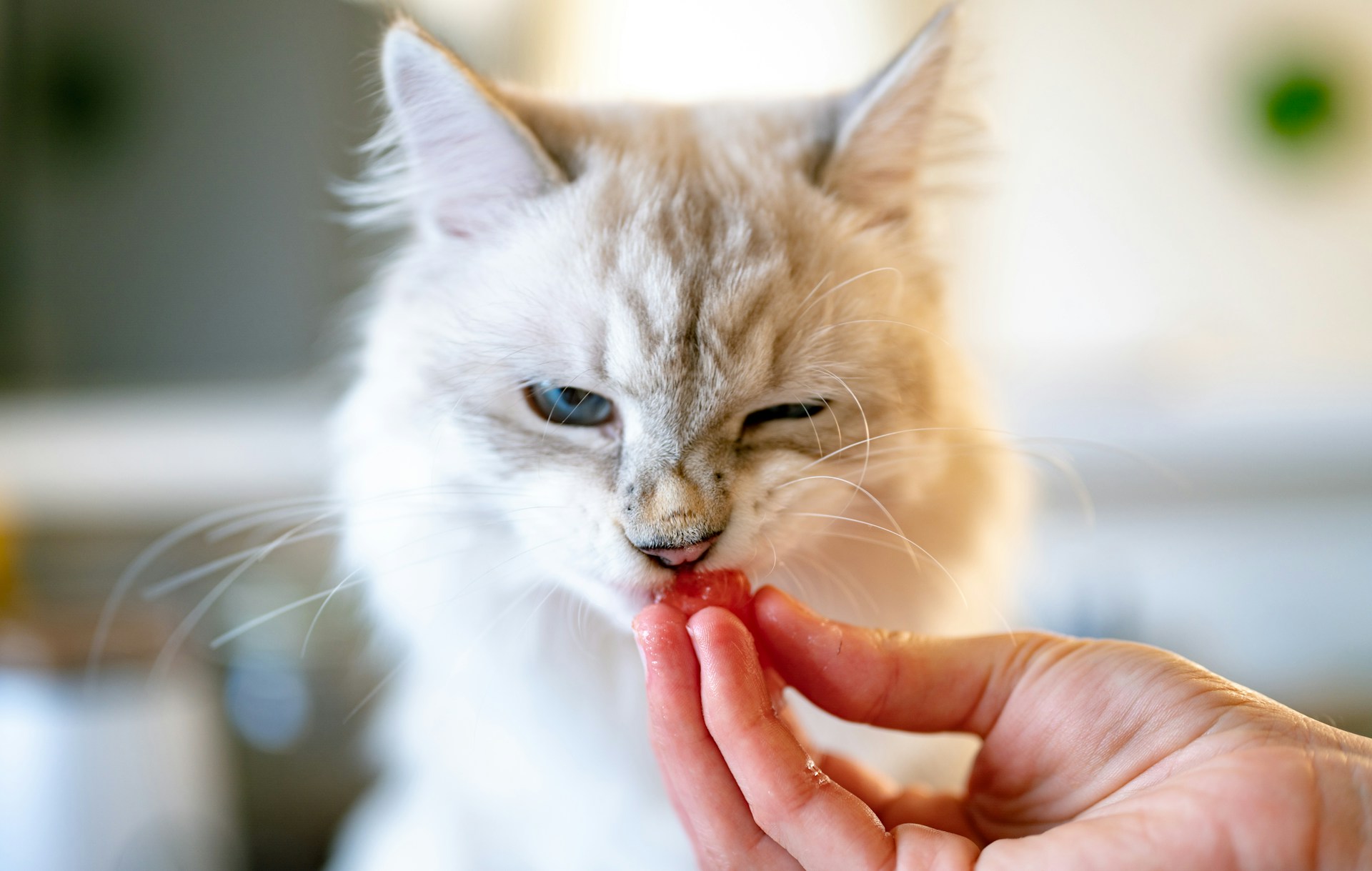
Wet food meatball — take a small amount of wet food (the smellier the better — tuna-based works well), mold it into a ball around the pill, and offer it as a “special treat” separate from their regular meal. Key detail: give one or two plain food balls first so they’re in the rhythm of eating before the pill arrives. Cats who are slightly suspicious will still often eat the second or third ball without thinking.
Pill Pockets — soft, moldable treats with a pocket specifically designed for a pill. Press the pill in, pinch it shut, done. Many cats eat these without hesitation. They come in chicken and salmon flavors. These are the single most useful product for pill-averse cats and worth keeping in your cupboard permanently.
Churu tube trick — this one is genuinely clever. Squeeze a small amount of Churu (a lickable cat treat that most cats lose their minds over) onto a plate or your finger, press the pill into it, and offer it. The strong flavor masks almost anything. You can also smear Churu over an empty gelatin capsule that contains the pill — the capsule becomes slippery and easy to swallow.
Important: Stay with your cat while they eat. Check the bowl or plate afterward. Cats are perfectly capable of eating around a pill, leaving it sitting in an empty bowl with an air of triumph. If your cat has done this once, they will do it again.
When They’ve Figured Out the Food Trick
Some cats — particularly those who’ve been on long-term medication — develop an almost supernatural ability to detect a pill in any food, no matter how well hidden. This is impressive and deeply annoying.
A few escalations before moving to manual techniques:
Gelatin capsules — buy empty size 3 or 4 gelatin capsules (available at pharmacies or online). Put the pill inside, close the capsule, coat it in butter, tuna juice, or cream cheese. The coating makes it slippery and harder to detect by smell. Many cats who reject bare pills will take a capsule this way.
The “sandwich” method — give a treat, then the pill-treat, then immediately another treat. The second treat triggers a swallow reflex and keeps their attention moving forward. Works remarkably well on food-motivated cats.
Switch to a different food — if your cat associates their regular wet food with pills, they may start refusing it. Try hiding the pill in something they don’t normally get — a tiny piece of cooked chicken, a small amount of plain meat-flavored baby food (no onion or garlic — check the label). Novelty helps.
The Manual Method: Direct Pilling
If food tricks have failed, you’re going direct. This is not as bad as it sounds if you do it correctly and calmly. The key word is calmly — the more tense you are, the more your cat will be. They read your body language precisely.
What you need:
- The pill, within reach but not visible yet
- A towel (optional but helpful for squirmy cats)
- A syringe with a small amount of water or tuna juice
- A treat for immediately afterward
The technique:
- Choose your moment. Don’t attempt this when your cat is already agitated, mid-grooming, or has just been disturbed. Ideally, approach them when they’re relaxed — not sleepy, just calm.
- Position your cat with their back against your body or on a non-slip surface facing away from you. If they’re a scratcher, the “burrito wrap” — rolling them gently in a towel with only the head exposed — is not cruel, it’s actually calming for many cats and protective for you.
- Hold the pill between your dominant thumb and index finger. Place your non-dominant hand over the top of your cat’s head, thumb on one side, fingers on the other, just behind the cheekbones. Tilt the head gently backward — the jaw tends to drop slightly when the head goes back.
- Use your dominant hand’s middle finger to gently open the lower jaw. Place the pill as far back on the center of the tongue as you can reach. Avoid the sides — pills placed to the side are spat out almost instantly.
- Close the mouth and hold it gently shut. Rub the throat downward or blow gently on the nose. A swallow response usually follows within a few seconds. You’ll feel it.
- Immediately give the water or tuna juice via syringe — a small squirt into the corner of the mouth helps the pill go down and prevents it from sitting in the esophagus, which can cause irritation. Then give the treat.
- Watch your cat for 30 seconds. Experienced pill-spitters can hold a pill in their cheek for an impressively long time and deposit it on your carpet the moment you turn away.
The Pill Gun (Your Fingers Will Thank You)
If you’re dealing with a biter, or if your cat has figured out how to dodge your fingers, a pill gun or cat piller is the answer. It’s a long plastic tube with a soft rubber tip that holds the pill and a plunger to release it.
The technique is the same as above — tilt the head back, open the jaw — but instead of your finger placing the pill, the piller does. Your fingers stay well clear of the teeth. The soft rubber tip is gentle on the mouth, and the length means you can deposit the pill further back than your finger can comfortably reach.
Ask your vet to demonstrate the first time if you can — it’s much easier to understand with a demonstration than from a description.
When Nothing Works: Ask About Alternatives
This is not failure. This is good veterinary communication.
Many medications are available in alternative forms that your vet may not mention unprompted — simply because not everyone needs them. Worth asking:
Liquid formulation — can often be given by syringe into the side of the mouth, which many cats tolerate better than a pill. Can sometimes be flavored (tuna, chicken) by a compounding pharmacy.
Transdermal gel — some medications can be compounded into a gel that you rub onto the inner surface of the ear flap, where it’s absorbed through the skin. You never open the cat’s mouth at all. Particularly useful for long-term medications like methimazole for hyperthyroidism.
Compounded chewable treats — some compounding pharmacies can make a cat’s specific medication into a flavored chewable that the cat takes willingly as a treat. Not available for every drug, and costs more, but worth asking about if you’re looking at months of daily pilling.
Injectable alternatives — for some conditions, a long-acting injectable given at the vet’s office can replace weeks of daily oral medication. Ask if this is an option before resigning yourself to a daily struggle.
Protecting Your Relationship With Your Cat
This is something the clinical guides tend to underemphasize: how you handle medication affects your relationship with your cat, and it’s worth thinking about deliberately.
If every pill session ends in a chase around the apartment, your cat will eventually start associating your approach with something bad — which makes everything harder, including vet visits, health checks, and general handling.
A few things that help:
- End every pill session with something positive — their favorite treat, a play session, calm stroking if they like it. The goal is that “pill time” doesn’t become a universally negative association.
- Don’t attempt pilling when you’re already stressed or running late. Cats read tension immediately. Five extra minutes of calm makes the whole thing faster.
- If you’re struggling with a long-term medication, consider asking your vet about a referral to a veterinary behaviorist or a Fear Free certified vet. They can work with you on techniques specific to your cat’s temperament.
The cat who gets their medication reliably, with minimal stress on both sides, is going to have better health outcomes than one whose owner dreads the process and occasionally skips doses. Getting this right is worth the effort.
Quick Reference: Which Method to Try First
| Your cat | Start here |
|---|---|
| Food-motivated, not suspicious yet | Pill Pocket or wet food meatball |
| Food-motivated but has figured out the trick | Churu + gelatin capsule |
| Not food-motivated / rejects all food tricks | Direct manual method |
| Biter or scratcher | Pill gun + burrito wrap |
| On long-term daily medication | Ask vet about transdermal or compounded options |
| Absolutely refuses everything | Discuss alternatives with your vet |
When to Call Your Vet
If your cat is consistently spitting out medication despite your best efforts, tell your vet. This is not an embarrassing admission — it’s important clinical information. Partially-completed antibiotic courses can contribute to resistance. Missed doses of heart or thyroid medication can have real health consequences.
Your vet has options. Use them.
For more on specific medications your cat might be prescribed — how they work, what to watch for, and when to call — see more in the Pharmacology & Veterinary Medications section.
Have a technique that works for your cat that we haven’t covered? Drop it in the comments — cat owners helping cat owners is how the best tips spread.
Leave a Reply